
Cue selection · Buying guide
How to Choose a Snooker Cue:Length, Weight, Tip Size and Balance
A cue should make your routine feel repeatable. Use the numbers as a starting point, then judge the cue by the way it supports your stance, delivery and touch.
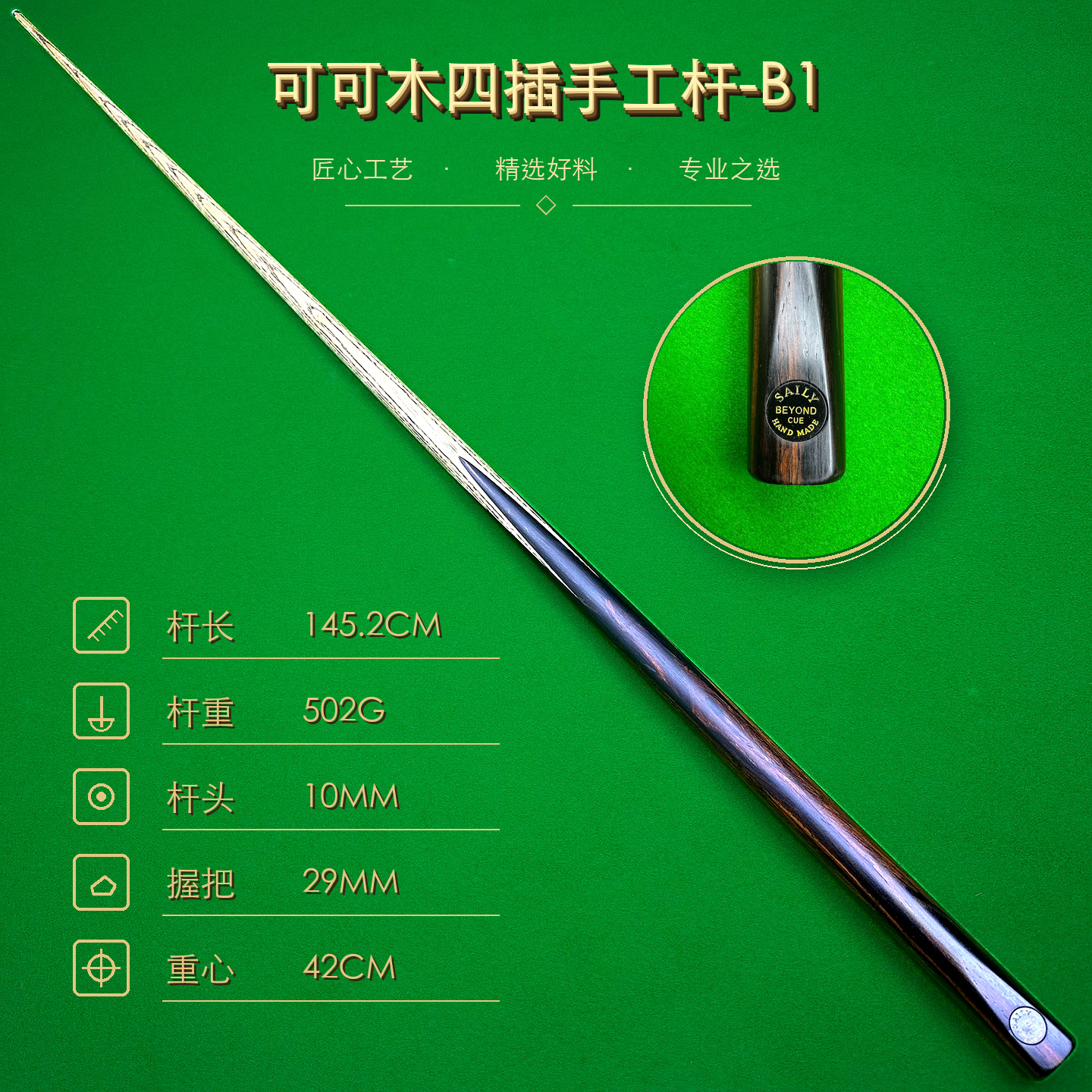
Short answer: there is no single “best” snooker cue. Choose a length that lets you settle comfortably, a weight you can accelerate and stop smoothly, a tip size that matches your contact confidence, and a balance point that feels stable through the whole delivery.
1. Start with your stance and playing space
Before comparing wood, decoration or price, check the environment in which you normally play. A standard snooker cue is designed for a full-size table and is usually close to 57–58 inches (145–147 cm). That length gives many adult players room to bridge, pause and finish without shortening the stroke.
Your height is only one part of the decision. Arm reach, bridge length, shoulder position and the amount of room behind you all matter. In a compact home room, a cue that is slightly shorter may be easier to use without changing your basic technique. On a full-size table, a full-length cue is often the simpler starting point.
Try to stand in your normal address position, not an exaggerated test stance. The butt should not force your rear hand into an awkward angle, and the shaft should clear your bridge hand without rubbing your chin or chest. Comfort that you can repeat is more useful than a measurement that looks ideal on paper.
2. Compare the core specifications
Length: a stable setup beats extra reach
Longer is not automatically better. Extra length can help a player with a long bridge or a tall stance, but it can also make a cue feel less familiar in a small room. Confirm the complete assembled length and ask how much space is needed behind the butt before ordering.
Weight: look for a controlled delivery
Weight changes how the cue starts, travels and stops. A lighter cue may feel quick and responsive; a heavier one may feel calm on slower shots. Neither description guarantees better cue-ball control. Hold the cue loosely, make several practice strokes, and check whether the cue returns to the same line without you forcing it.
Tip size: precision and forgiveness are a trade-off
Snooker tips are typically smaller than pool tips. A 9–10 mm tip can provide a clear contact point for a precise cue-ball strike, while a little more surface area may feel forgiving during learning. Ask about the actual installed diameter, tip shape and hardness. These details can change the feel as much as one millimetre of diameter.
3. Understand balance, taper and grip feel
The balance point is the place where the cue feels level when supported on one finger. A front-balanced cue can feel connected to the bridge hand, while a rear-balanced cue may feel easier to guide from the grip. A near-centre balance can feel neutral. These are descriptions, not quality grades.
Taper and handle shape influence how the cue moves through your fingers. A smooth, gradual shaft taper may suit a long, relaxed bridge; a different taper may feel more direct during shorter strokes. The butt diameter and finish should let your rear hand stay relaxed. If you need to squeeze the cue to keep it steady, the specification is not working for you, whatever the balance measurement says.
When possible, compare two cues with similar length and weight but different balance points. Make the same three shots with each. Notice the pause, the forward delivery and the finish—not just the result of one ball.
4. A practical checklist before you buy
- Confirm the complete length.Ask whether the listed measurement is assembled and whether a joint or extension changes it.
- Check the measured weight.Find out whether the weight includes the joint, butt cap and tip. Small differences are normal.
- Ask for tip and butt measurements.Diameter, tip condition and handle shape are more useful than a vague “standard” label.
- Request the balance point.Use it as a comparison point, then judge the feel with your own bridge and grip.
- Inspect straightness and finish.View the shaft in good light, check the joint and ask how the cue should be stored.
- Match the cue to your practice.Choose a setup you can use consistently, not the most extreme specification in the catalogue.
Request clear photos of the shaft, joint, butt and tip, plus the actual measured specifications. A transparent product description is more valuable than a promise of automatic improvement.
5. Common cue-buying mistakes
Choosing by weight alone
Weight cannot tell you how a cue will balance or how the shaft will feel during a pause. Compare the full set of measurements.
Assuming a smaller tip always means more accuracy
Tip diameter is only one part of contact. Tip shape, hardness, chalk, delivery and practice all affect the shot.
Copying a professional player’s setup
A professional’s cue reflects their body, technique and table conditions. Use their equipment as a reference, not as a prescription.
Ignoring aftercare
Store the cue straight, protect it from rapid humidity changes and keep the tip in usable condition. Good care preserves the feel you selected.
6. Snooker cue buying FAQ
What is the best length for a snooker cue?
A full-length cue around 57–58 inches (about 145–147 cm) suits many adult players, but it is not a rule. Your stance, reach, table space and comfort matter more than a single number. A shorter cue can be useful in a tight room or for a player who finds a standard cue difficult to control.
How heavy should a snooker cue be?
Many players are comfortable around 17–19 ounces, although there is no universal best weight. A lighter cue may feel quicker through the cue ball, while a heavier cue can feel more settled. Test whether you can deliver it smoothly at both soft and firm speeds before choosing.
What tip size should a snooker cue have?
Snooker cues commonly use a smaller tip than pool cues, often around 9–10 mm. Smaller tips can offer a precise contact point, while a slightly larger tip may feel more forgiving. Tip shape, hardness and your technique also affect the result, so diameter alone cannot determine playability.
Should I choose a front-balanced or rear-balanced cue?
Balance is a feel preference rather than a ranking. A front-balanced cue may feel more planted near the bridge hand; a rear-balanced cue can feel lighter in the front during the delivery. The useful test is whether the cue stays stable when you pause, feather and finish the stroke.
When two candidates both meet the basic fit and specification checks, use the controlled two-cue A–B test to compare them under the same table conditions without treating one pot or one number as a verdict.
SAILY CUE COLLECTION
Compare real cue measurements
Browse the English cue catalogue for individual photography, length, weight, tip diameter, butt diameter and balance details. You can also view the Cocobolo Four-Splice Handmade Cue B1 as a concrete example.