
CUE SPECIFICATIONS · HOME CHECK
How to Measure a Snooker Cue Balance Point at Home
Find where an assembled cue rests level, measure from a stated reference and record the result in a way that makes honest cue-to-cue comparisons possible.
Short answer: assemble the cue in its normal playing configuration, rest it across a narrow stable support, move it slowly until it sits level, mark that support position and measure from the extreme butt end. Repeat before recording the result.
What a snooker cue balance point tells you
The balance point is the location along a cue where its weight can rest level on a support. Sellers commonly state it as a distance from the butt end. That number helps describe how the cue’s mass is distributed, but it does not describe the whole playing feel.
A cue’s complete length, total weight, taper, butt diameter and the position of your bridge and grip all influence what you feel during a pause and delivery. Two cues can share a balance-point figure and still feel different. Treat the measurement as one comparable specification, not a rating of quality or a promise of performance.
The reference point matters. “42 cm balance” is incomplete if one person measures from the bumper edge and another begins at a decorative line above the butt. For a repeatable home method, this guide uses the extreme butt end of the assembled cue as zero.
What you need before measuring
- A clean cue assembled in its normal playing configuration, without an extension.
- A stable table or work surface with enough clear space for the complete cue.
- A narrow, smooth support such as a rounded dowel or the protected edge of a small block.
- A tape measure or ruler long enough to reach from the butt to the support position.
- A removable paper tab or another non-marking way to note the location.
Protect the cue finish and the table. Do not balance the cue on a sharp metal edge, clamp it or press it down. Keep one hand close enough to catch the cue if it starts to roll, without touching it while you judge the level position.
If the cue has a detachable extension, remove it unless you specifically want to measure the extended playing configuration. Record that configuration separately so the figure cannot be confused with the standard cue measurement.
How to measure the balance point step by step
- Assemble the cue correctly.Seat the joint normally and confirm that no extension or temporary accessory changes the configuration.
- Lay out the measuring line.Place the ruler or tape parallel to the cue with zero at the extreme butt end.
- Start near the expected area.Rest the cue across the protected support and keep a hand nearby to prevent a fall.
- Move the cue in small steps.Slide it gently until neither the shaft nor butt consistently drops.
- Mark the support centre.Use the centre of the contact area, not one outside edge of a wide support.
- Measure from the butt.Read the distance from the stated zero point to the support centre.
- Repeat the check.Lift the cue, reset it and take at least two more readings before recording a sensible result.
A narrow support gives a clearer location than a broad palm or several fingers. However, the support still has width, so avoid reporting false precision. If repeated readings cluster around 42 cm, “about 42 cm from the butt” is more credible than a fraction your method cannot reliably resolve.
How to compare balance-point measurements
Compare cues only when the method is the same. Use assembled cues, the same butt-end zero, a similar support and the same unit. Also record the complete length and weight, because a balance distance without those figures can be misleading.
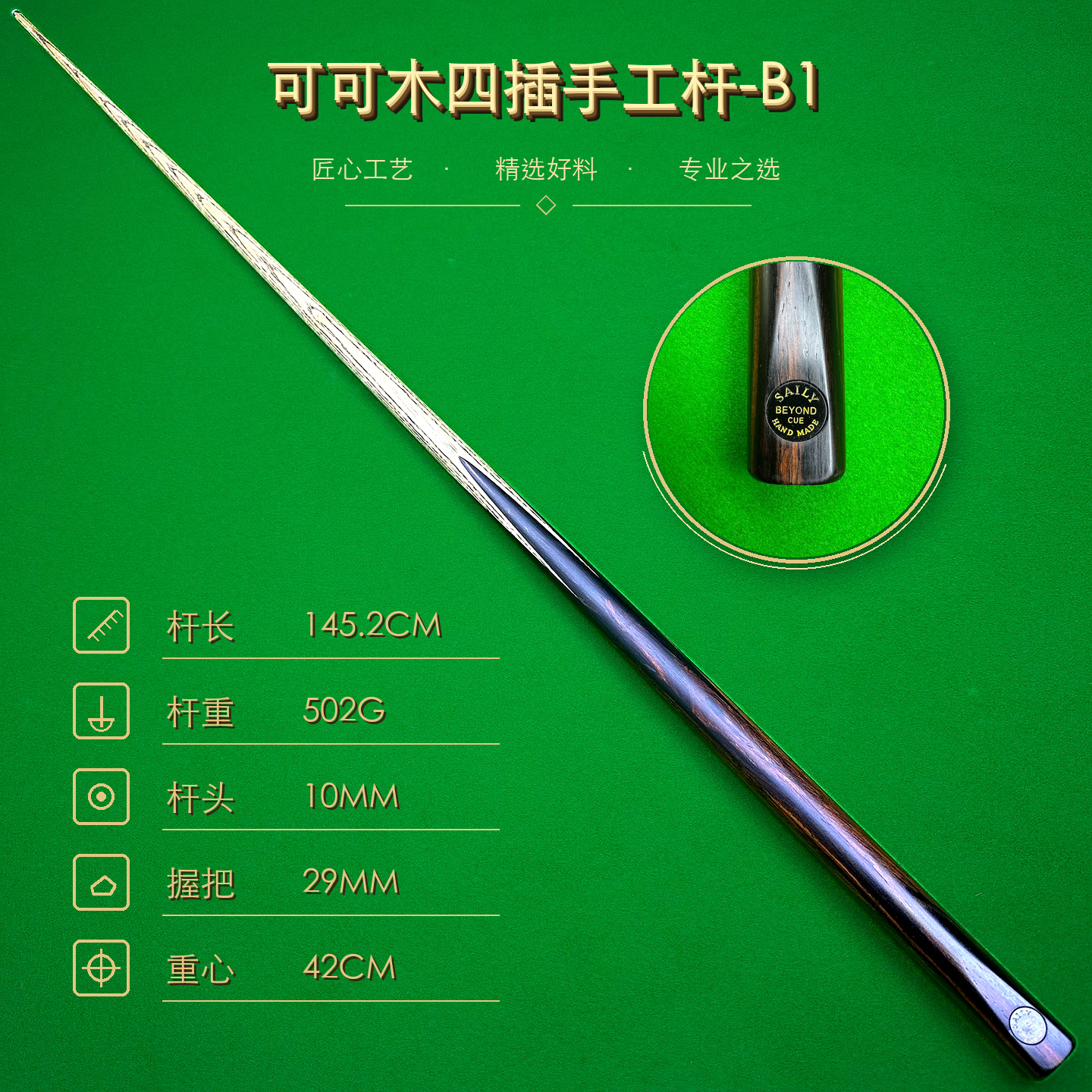
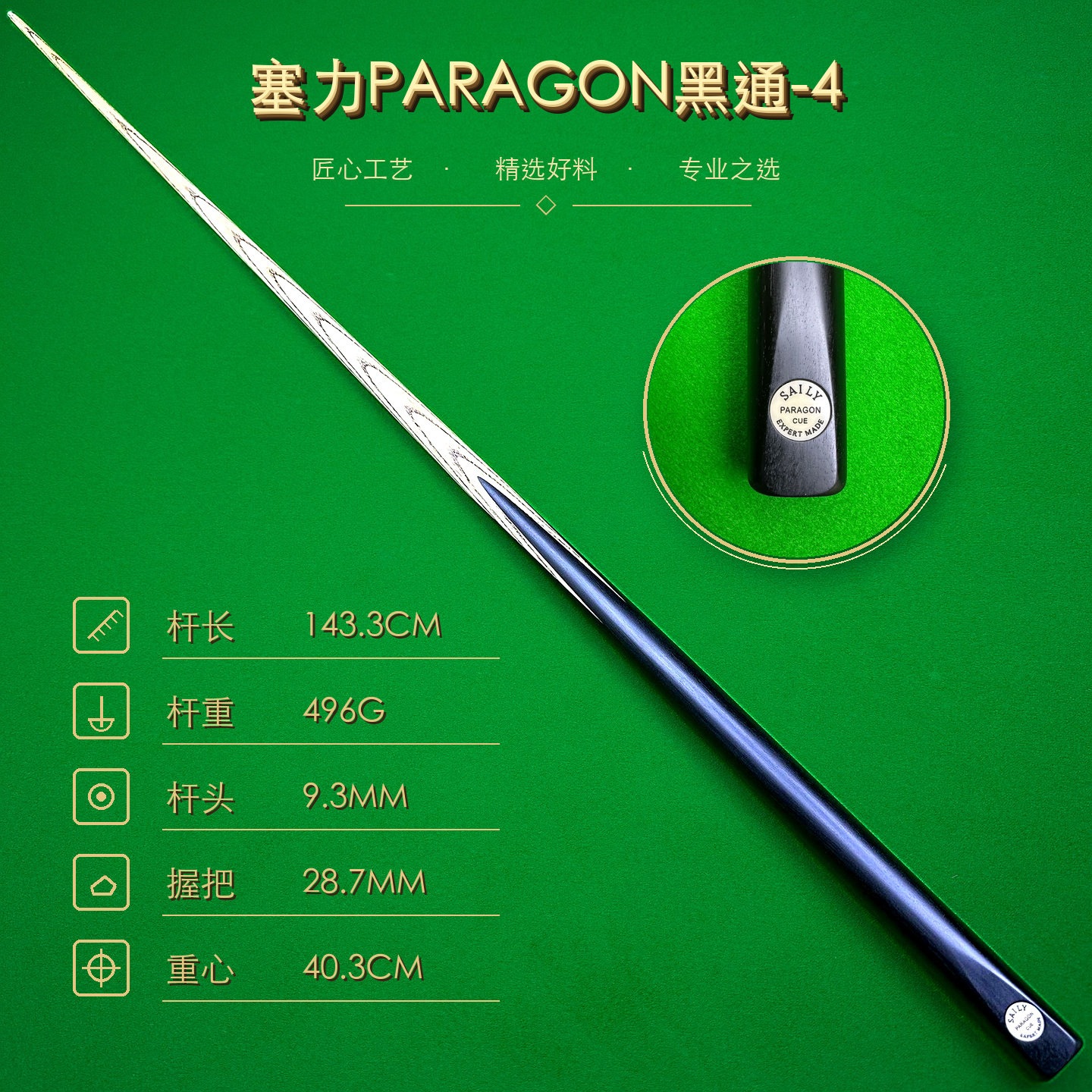
For example, the documented SAILY CUE Cocobolo Four-Splice Handmade Cue B1 is listed at 145.2 cm, 502 g and a 42 cm balance point. The Paragon Ebony No. 4 is listed at 143.3 cm, 496 g and a 40.3 cm balance point. Those are product-specific measured records, not universal targets.
The numbers let a buyer ask a better question: how does this cue compare with one I already know? They do not establish that one cue is more accurate, better made or suitable for every player. If possible, combine the record with a few relaxed practice strokes and note where your normal rear hand sits relative to the measured point.
Make a useful equipment note
Record the cue name, assembled length, weight, balance point, measurement reference, configuration and date. If you measure again later, use the same method. A small difference may reflect support placement or reading error rather than a physical change in the cue.
Common balance-point measurement errors
Measuring separate cue sections
A shaft-only or butt-only balance check is not comparable with the assembled playing cue. State the configuration clearly.
Changing the zero point
Beginning at the butt cap on one cue and at the bumper edge on another can create an artificial difference. Use the extreme butt end consistently.
Using a hand as a wide support
A palm or several fingers can make a broad range appear balanced. Use a stable, protected and narrower contact surface.
Judging feel from the number alone
Balance point does not replace length, weight, tip, taper, butt diameter or a condition check. Continue with the complete snooker cue selection guide and the cue straightness buyer check before making a purchase decision.
A repeatable home check supports comparison. It is not a laboratory certification and does not prove how well a cue will play for a particular person.
Snooker cue balance-point FAQ
Where do I measure a snooker cue balance point from?
Use a clearly stated reference and keep it consistent. This guide measures from the extreme butt end of the fully assembled cue to the point where it balances level.
Should I measure the cue assembled or in two pieces?
Measure it fully assembled in its normal playing configuration. Measuring separate sections answers a different question and cannot be compared directly with an assembled-cue figure.
Does a farther-forward balance point mean a better cue?
No. Balance point is a comparison measurement, not a quality grade. Length, weight, taper, butt diameter and the player’s bridge and grip also affect feel.
How accurate is a balance-point measurement at home?
A careful home measurement is useful for comparison, but the support width, cue position and ruler can introduce small differences. Repeat the measurement and report a sensible precision rather than claiming laboratory accuracy.
SAILY CUE COLLECTION
Compare documented cue specifications
Browse real cue photographs with individual length, weight, tip, butt and balance-point records.